How Are Condoms Made? From Latex to Foil
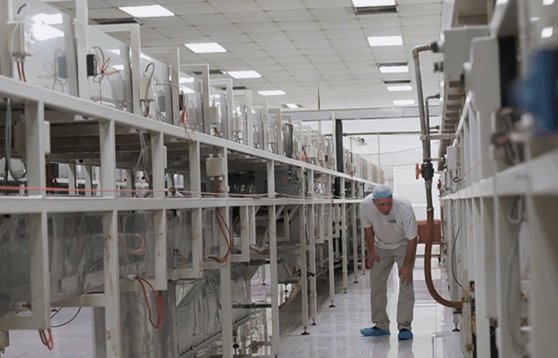
A condom looks simple, but every one goes through a tightly controlled manufacturing process and a series of quality tests before it is sealed in its foil. Condoms are medical devices, and the standards they are made to are strict.
This guide explains how latex condoms are made, how they are tested, and what happens before a batch is released for sale. It is written for retailers, distributors, public health buyers and brands planning their own range.
It starts with natural rubber latex
Most condoms are made from natural rubber latex, the milky sap tapped from rubber trees. The latex is concentrated, then compounded with ingredients that allow it to be cured into a strong, stretchy film, and left to mature before it is used.
The source and formulation of the latex can be part of a brand’s story. LTC Healthcare’s private label range includes sustainable latex from the Regenerative Rubber Initiative and Vytex latex, a formulation with a low protein count. For people who cannot use latex, non-latex condoms are made from synthetic materials, and these are tested to their own standard, ISO 23409.
Dipping: how a condom gets its shape
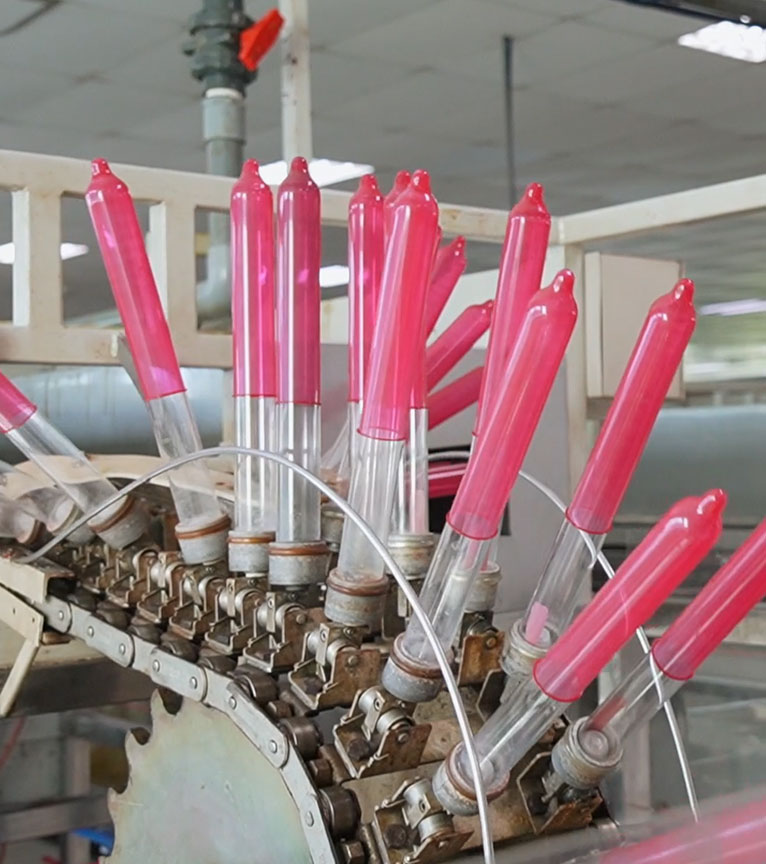
Condoms are formed on moulds called formers, which are shaped like the finished condom, including any flared, contoured or textured design. On an automated line, rows of formers are dipped into the latex compound, usually more than once, to build up a thin, even film.
The formers turn as they move so the latex spreads evenly, and heat dries each layer. The rolled ring at the open end of the condom is formed at this stage too. The thickness of the film is what separates a regular condom from a thin or extra thick one, which is why consistent dipping matters.

Curing, leaching and drying
Once the film is formed, the condoms are cured, or vulcanised, with heat. Curing turns the soft latex film into the strong, elastic material a condom needs to be.
The condoms are then stripped from the formers and washed, a step called leaching, which removes residual chemicals and some of the natural latex proteins. They are dried and lightly powdered so they do not stick together before testing.
Electronic testing of every condom
Before packing, condoms are electronically tested. Each condom is placed on a metal mandrel and passed through an electrical test. Latex does not conduct electricity, so current only flows where there is a hole or a thin spot, and any condom that fails is rejected automatically.
Electronic testing checks every individual condom, which is why it is standard practice for reputable manufacturers. EXS condoms supplied by LTC Healthcare are electronically tested. Shoppers can read more about how EXS tests its condoms.
Batch testing to ISO 4074
ISO 4074 is the international standard for natural rubber latex condoms, published in Europe as EN ISO 4074. It sets out the tests a batch must pass and how many condoms must be sampled for each one. The main tests are:
Each test uses a sampling plan with an acceptable quality limit, and the limits are strict. In procurement specifications built on ISO 4074, for example, freedom from holes is commonly set at an acceptable quality limit of 0.25. If a sample has more failures than the plan allows, the whole batch is rejected.

Lubricating, foiling and packing
Condoms that pass testing are rolled, lubricated and sealed into individual foils. Silicone lubricant is widely used on latex condoms, and the EXS range uses silicone-lubricated natural latex condoms. Each foil is printed with the batch number and expiry date so every condom can be traced.
Foils are then packed into retail boxes or bulk packs. For private label customers, this is where your printed foils and branded packaging come in.

Shelf life, stability and batch release
The expiry date on a condom is backed by stability testing, which shows that condoms still meet the standard at the end of their shelf life. Before a batch is released, the manufacturer checks that it has passed every required test and that its documentation is complete.
LTC Healthcare works with exclusive manufacturing partners in Malaysia and Thailand and only works with SMETA-approved factories. Our factory quality assurance team checks every batch against the safety and regulatory requirements of its target market before it ships. For more on the rules behind these checks, read our guide to condom regulations in the UK and EU.
How condoms are made: FAQs
Is every condom tested?
Reputable manufacturers, including the factories that make EXS condoms, electronically test every condom for holes. Samples from each batch are then tested for strength, leaks, dimensions, visible defects and packaging.
Are thin condoms tested to the same standard?
Yes. Thin condoms have to pass the same tests as regular condoms. Our guide to whether thin condoms are safe explains more.
What are condoms made of?
Most condoms are made from natural rubber latex. Non-latex condoms are made from synthetic materials for people with a latex allergy or sensitivity.
Why do condoms have expiry dates?
Latex changes slowly over time. Stability testing shows how long condoms keep meeting the standard, and that sets the expiry date. See our guide to condom storage and expiry dates.
Quality condoms for your customers or your brand
LTC Healthcare has supplied condoms since 1993 and supplies around 25 million condoms a year to retailers, distributors, public health services and private label brands.